.
|
|
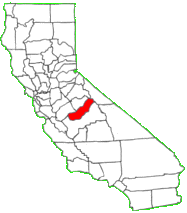
Madera County, California
GenWeb
|
.. |
 ..
..
Madera Biographies: Johnny Alberta Jones
|
JOHNNY ALBERTA JONES
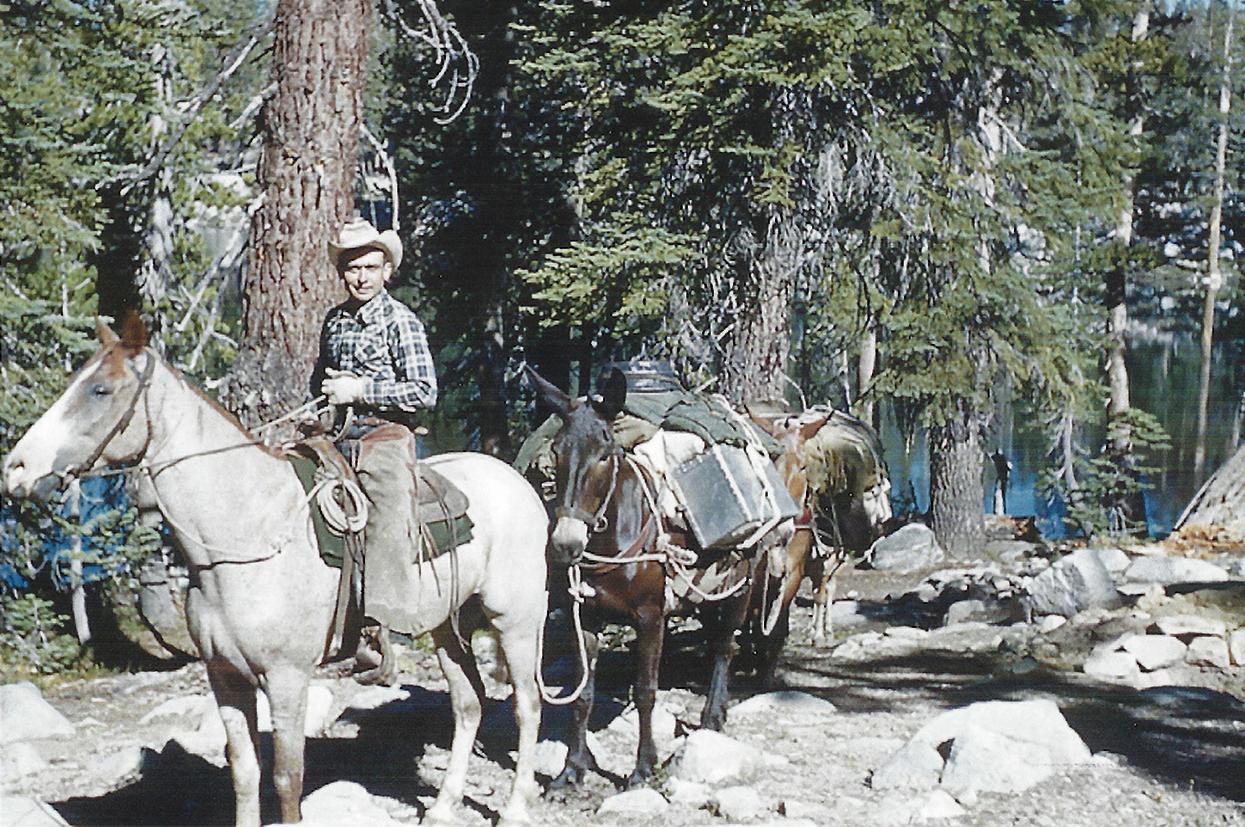
Johnny Alberta Jones was born on 30 Oct 1918 in Patterson, Stanislaus Co., CA, the son of Manuel Rigo Alberta and Mary Carne Mello. He was born John Alberta. In 1920, 1930, and 1940 he worked on the alfalfa farm of his father on Olive Avenue in Patterson. He spent his summers with Tom and Ella Jones at Beasore Meadows and took their name, keeping his father's name in the middle. On his WWII draft registration he listed his name as Johnny Jones Elberta with the person who would always know his address as Tom Jones in Coarsegold. In married Mary Dell Lyons on 23 May 1946 in Carson City, Nevada as Johnny A. Jones. Their daughter Jenene Jones was born on 18 July 1946 in Madera County. In 1950 he worked on a ranch in Coarsegold with Mary and Jenene. After an exciting career as a backpacker, even for Ronald Reagan, and raising mules he passed on 25 July 1993 and was buried in Oakhill Cemetery in Oakhurst.
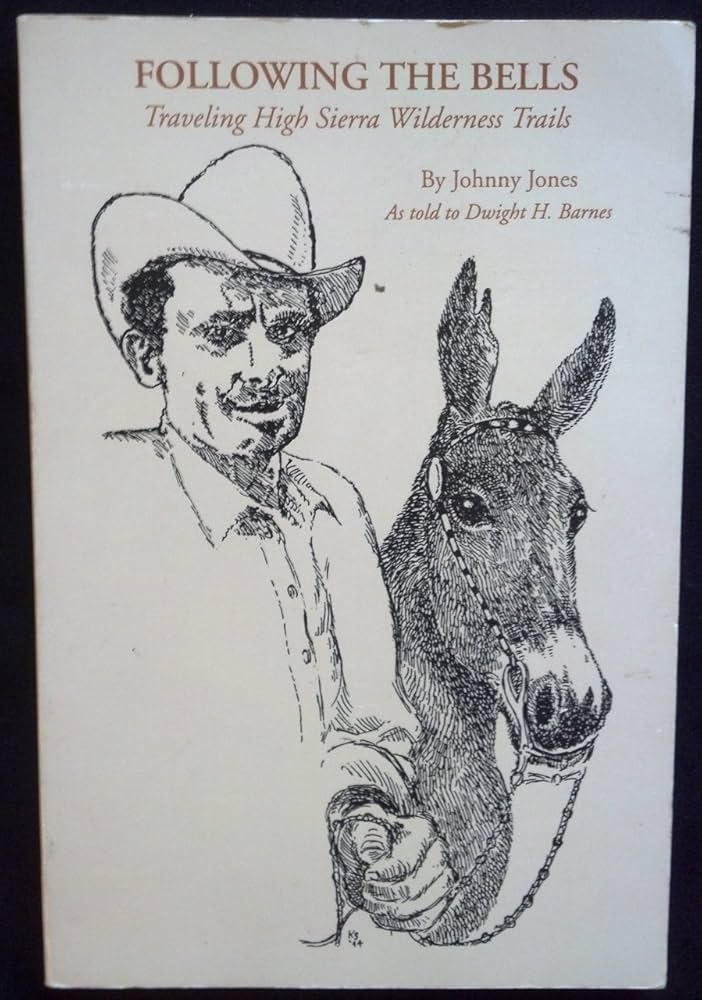
His life is documented in the book, Following the Bells - Traveling High Sierra Wilderness Trails. A flavor is in Johnny's own words spoken in 1984 at the Coarsegold Community Center.
Following the Bells with more in As We Were Told available at https://coarsegoldhistoricalsociety.com/support/gift-shop/.
I was born in Patterson, California, on the west side of the state. In that area, they had a lot of alfalfa. We little kids had to put up alfalfa hay. I took the easy job. I had to rake it with a horse when I was just big enough to sit in a seat--five or six years old. I also had to milk two cows; we had a dairy herd and fruit trees.
We had a neighbor, Obert Bundy, an old fellow, I would go to
visit. He retired and sold his forty acres and came to see his
brother and nephew in Madera; he went for the summer to Beasore
Meadows, and bless his heart, he thought about me. That old
gentleman--if it hadn't been for him, I would have been dead years
ago for I had allergies--came and asked my parents if he could take
me up to Beasore. When I got up there, I could breathe. I saw those
beautiful green meadows
I was living with him in a tent, and
Tom and Ella QUESTION: How old were you? JOHNNY: Oh, I don't know. Seven or eight? Ervin (E.T.) Whitfield said I didn't even make a good shadow when he saw me first--said I was a little old, skinny thing. QUESTION: Had you come up several summers with Mr. Bundy? JOHNNY: No, I came up that summer with him. I liked it; I got to helping the Joneses. Matter of fact, I liked horses; I had been around teams, but I wasn't around too many saddle horses, although we did have a saddle horse at home. I just felt I knew quite a bit about them because I grew up with them--just like with cattle. QUESTION: Did the Joneses have any children? JOHNNY: No, Tom and Ella didn't have children, but Ella did have two grown daughters from a previous marriage. People started coming around and in a year or two the Joneses got me to stay with them. Then I came up every summer. I got to following Tom Jones with a pack train, learning the country, and people would say, "Is that your boy?" He would say, "Yeah, that's our boy," and Ella would say, "Yeah, that's my boy," and she would put her arms around me sometimes. So, I grew up as "Johnny Jones." I even was getting mail to "Johnny Jones." I legally changed my name but I kept my true last name, Alberta, for my middle name. So, I have this acquired Welsh-Indian name, which has come by living with and growing up with the Joneses. Then, as the years went on--it wasn't too many years-I quit school. I had been going back home to school, but I would have liked to have gone to school here. I went my first year to high school and took agriculture. I missed the mountains so badly, the healthy climate, that I just quit and came up. My real daddy had died of a heart attack and the Joneses wanted to adopt me, but I just stalled around saying, "We'll see." I loved it up here at the ranch. They had a house on the ranch; the Tom Jones Ranch is about four miles north of Coarsegold, west of Highway 41. I spent the winters there and followed the snow up as it melted in the summer. As I got older, Tom got older, and I was doing all the guiding and packing people back into the high country. Tom Jones was a cattleman and one of the old-time packers who conducted pack trips. He was Welsh and Indian. E. T. Whitfield was Tom Jones' nephew; E. T.'s mother was a sister of Tom. In Tom Jones's family were four boys and eight girls.
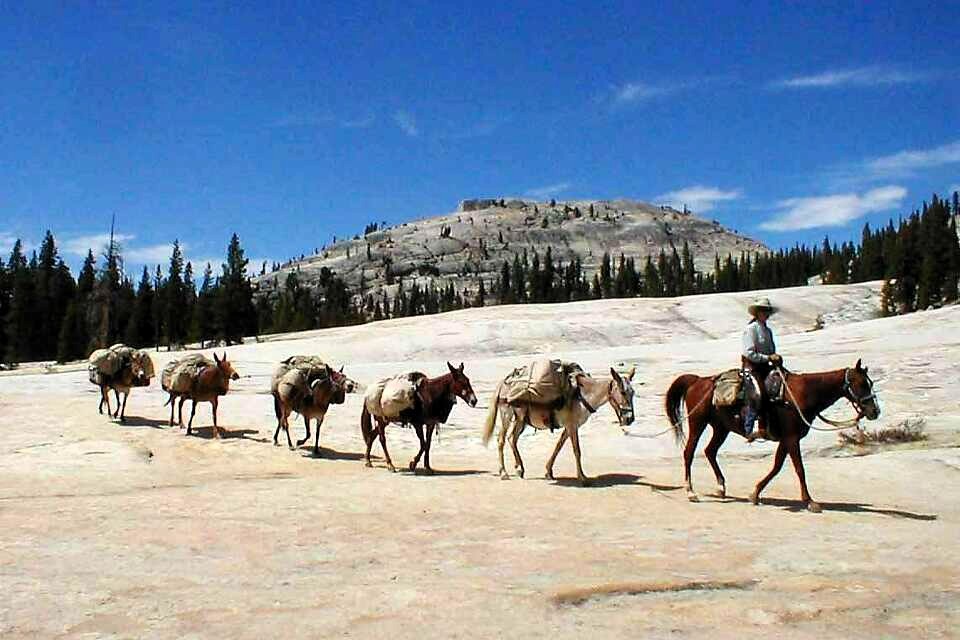
QUESTION: Please tell us about the Soldier Meadow. JOHNNY: The Soldier Meadow. . . 1 did packing in the area for years, but I was always busy and not looking at trees. I heard when I was a little kid, from the old-timers, that a soldier had died there as he patrolled the area (keeping stockmen and sheep out of the National Park). That's all I knew until about five years ago we were on a little trip by ourselves--my wife Jan, and 1--and we had a lot of time. She saw a tree and she said, "Did you see that tree, Johnny?" I said, "What tree?" She said, "There's a tree there and it has carving on it." There was a big square out of it and they had carved right in the wood, "Private -- Minaret Mining Co. 1916." I went over there and she showed it to me and I said, "My goodness!" The tree was already split and dead and was going to fall in a few years. The word got out and a member of the Oakhurst E Clampus Vitus got in touch with me; I took him up and showed it to him, and, gosh, he just went wild, and he took pictures of it. That summer he said the Clampers were going to get it and get in touch with the Forest Service. They went up there, and there was a Forest Service employee cutting dead wood. He had already felled the tree, but luckily, he saw the carving on it. It was so beautiful that he cut around it; it was too bad he didn't leave more. It was only about four to five feet long. I met him on the road, and he had it in the pick-up. Eventually the tree carving was taken to the Oakhurst U.S. Forest Service Office. It seems it might have belonged to the "Minaret Mining Company" and the word "Private" meant "Keep Out." What was it doing in Soldier Meadow? I think it's really history because that dates 'way back. There was a soldier battalion that patrolled Yosemite Park for years; as a matter of fact, I believe that's how the Minarets (aged peaks) got its name. There's a big high peak on the Ritter Range called Minaret, and there are Minaret Mines on the Ritter Range slope. One day I was guiding a group of people in the park on a "spot pack", and I was going after them. Some pack trip groups would want to "spot trip". A "spot" is a trip where you would take them in and leave them on a beautiful lake or river. You'd return on a certain date and bring the family or the group out. I was a little late and the trail went 'way around. I was always one that liked the wilderness and I'd take cut-offs, always exploring with my pack train; sometimes you get in some real rocky places. You have to pick your way and you can't always get through and you lose time. This particular time, I hit a big, beautiful meadow. I was right on a bee-line with a particular lake where I had to go to pick up my party. I went down to the big, beautiful meadow, and there were the remains of hewn timbers and a little cabin all toppled over. I was about fifteen years old at the time, and I rode up there; on this old tree there were a few empty cartridges driven into the tree. I was still on my horse, so I put some of the cartridges in my pocket and away I went to pick the people up. I got in, loaded up and we were on our way "home" to Beasore Meadows. At Beasore was a little store--just a little, old store at that time--an old rickety one, which they later tore down. (It would have been over 100 years old now!) I took these cartridges out and showed them to some old-timers who were there; they said, "Where did you get these?" They asked a whole bunch of questions. One old man came around about four or five days later after they got the word out and he said, "Oh, that had to be a soldiers' camp." The old man described the cavalry (Which patrolled Yosemite National Park). There was a battalion of cavalry up that way, armed and mounted; that explained the empty cartridges. I had Les Whitfield, who was born here in Hawkins Valley, with me back in the mountains one time. I was probably about eighteen then. We went way back at the foot of the Ritter Range at Iron Mountain, above Seventy-Seven Corral. Dr. Kenneth Butler from Madera, Young Corbett III from Fresno (the fighter, nice fellow), a guy that owned the Club LaConga, George Rodgers, and about twelve other men were in the party. They were all friends of Buddy Freeman, the original builder and owner of Ducey's at Bass Lake. We went in for hunting and fishing. One day, I left camp by myself; it started to get dark and stormy. I always tell myself, "You look, you think first before you make any moves. Use your head instead of your feet." So, I was walking in a hurry to get back into camp. I was a kid about eighteen, and I made a bee-line just walking and looking. As I hurried along, I saw obsidian lying all over the ground and I noticed pestles still standing in the granite holes where they had been left. I wanted to stop but I couldn't. I said, "I'll be back!" I know where the general area is. It was the biggest Indian camp I've ever witnessed in my life. When I saw Otis Teaford about a year or two later, he said, "John, please take me there. That is where my forefathers camped when we traded obsidian on the other side--I mean, we traded for acorns. That's where they stayed and hunted and fished and came out down river and I've never been back." Otis never did push me, and then he passed away, but I am going back. One time a man I know was bulldozing a road up there just this side of Poison Meadow on the road to Beasore Meadow. He was widening it with a tractor, and all of a sudden, he dug up a whole bunch of arrowheads and spearheads; they just fell off the cut in the bank. The bulldozer operator told me a few years ago he was short of money at one time and sold them; he didn't know what he had, so he sold them to a collector. After the collector paid him, he said, "Did you know they were prehistoric?" My friend about died, but he had already sold them. I've learned so much from our Indians. I grew up with them. The Indians taught me "search and rescue." It's pretty much like looking for lost livestock. In the old days, if you were searching by yourself, you'd walk in a big circle about a mile in diameter and "hub in", making the circle smaller. That's how I was taught. We'd just comb it, closing in on the area. If you had two of you, the best way was to stay with the terrain, just circle and "hub in" and continue your circles until you found the person--lost, hurt, or dead. I could find them easily. For "search and rescue" years ago, the Forest Service would call us and send a ranger or two with us. The old-time ranger was a practical man. He would spend a lot of his time on horseback in the mountains touring the country. The rangers then traveled on horseback, took their mule, and carried their "home" with them--their tent and their food. It has completely changed now. When I was a little kid I plowed with a side-hill plow--a plow that just goes on a side of the hill. A sidehill plow has a lever that would turn the plow shear down and throw the dirt the same direction as you go back and forth. We used to raise our hay then. We had hogs, too. My "bedroom" was an old blacksmith shop, believe it or not, with a dirt floor, and an anvil sitting there. The pack rats would crawl over the top of me at night, and I'd swat at them. I got used to it--just made up my mind that it was so nice to be able to breathe that I was going to stay. The old shop didn't have bats on it; it had large cracks and once in a while the rain would come in and I'd put a canvas over the top of my head. I must have really loved it up here! It was an interesting life. I worked hard because Tom was getting old and I was always a worry-wart always wanting to do something, always particular. I was told when I was a little kid, "If anything is worth doing, do it right!" There was only one way--right! QUESTION: Where was Ella Jones from? JOHNNY: The nearest I could find out, Ella was related to the Wagner family of Coarsegold and was raised around Bagby and the Mariposa area. I believe she's related to the Oylers. She was close to me, good to me, bless her heart, but she was awfully sick. There's no town at Bagby now; Lake McClure covers it up. She had two daughters from a previous marriage: Essie, who lived in Nevada City, and Stella Smith. Essie had a daughter, Merle, who married Henry Douglas from O'Neals. He died up at the Strawberry Mine one winter. Tom Jones was raised up at Hawkins Valley. There were four boys and eight girls. His dad was buried at Hawkins Valley. Tom depended upon me and I started doing the guiding. As I got a little bigger and a little stronger, I was doing a lot of the traveling on the trails when I was about fourteen to sixteen years old. I was willing; I could tie the hitches--I learned that. I'd get the horses or mules up by a log and stand on the log to tie the hitches. I'd get the horse down hill and turn him around on the other side, and pack him. To get ready for a pack trip, a group usually contacted you or they’d drive up and have all the food and tents with them. They usually made reservations, but years ago there wasn't too much of that. They would drive up and sometimes they'd be camped, maybe vacationing. They might be camped by the creek until they could have us take them back into higher country. They’d have their food, their tents, and their bedrolls. That was before there were any sleeping bags; I didn't know what one was. I slept in some blankets and I'd get back in the high country and it would get cold! I'd use the horse blanket--saddle blankets--to make a pad. With some of the parties we departed from Beasore Meadows. Some who went back farther, we'd meet at the trailhead of the backpacking road. They would drive a little farther than Beasore and wouldn't have to ride a horse or the mule quite so far. At Beasore Meadows, there was a little old store and a camp ground. A lot of families stayed there and we had, in the meadow, two or three milk cows. Around the Fourth of July we'd have to round those up, put the calves in the corral over night, and in the morning steal the milk from the cows for the campers. I'd have to do that. I'd walk that hundred acres for hours in the evening bringing those cows and calves in, like a sheepherder with a stick; it was cold and the grass was wet! I put the calves in the corral where they wouldn't suck their mamas at night, so that the cows would have milk in the morning. We'd strain the milk and bottle it. Some people, with their children, stayed at Beasore for months. Tom Jones told me he and Tom Beasore grew up together. I don't remember John, the daddy of Tom Beasore. I remember Tom Beasore because we used to go over there to stack hay for him, around the Model-T because it was stored in the barn, too. I didn't know much about cars but that was a really weird-looking, little car. Tom and I stacked hay up against it in that barn for Mr. Beasore. He always had a nice garden and we'd pick corn. Tom told me there were four boys. Tom Beasore and Tom Jones got to be good friends. The Beasores ran a lot of cattle on the open range. He hired Tom Jones to work for him for a dollar a month and board or five dollars a month without board. Tom Jones grew up with Tom Beasore; they were just like brothers. They always used to go see each other. Tom Beasore's will read like this: If Tom Beasore died first, Tom Jones got the meadow. If Tom Jones died first the meadow went back to Tom Beasore. Tom Jones got the meadow because Tom Beasore died before Tom Jones. Later, Ella Jones passed away and Tom married Hilda Black, an awfully nice lady. The Blacks were friends of the family. Tom Beasore's father was a Frenchman and his mother was Indian. When I was there as a little kid, Tom Beasore would come in the summer months and take off for the high country in the snow (the high pass would melt). He'd always go back to his mines--gold and silver mines up there. Nobody knows where they are. He'd come, and he'd stop at Beasore Meadows; he was younger and pretty spry then, and he'd stay under some fir trees out in the meadow. As time went by, he got pretty feeble. He had no business going alone but he really was a stubborn man. I got to know him better and he liked me. He asked me to go back with him one time but Ella wouldn't let me go. I wish I had; I would have learned so much. He told me he had a "bank" back there. He'd go to Red's Meadow and buy his food. He had gold pieces in a can he had buried there by a tree where he camped, just off of Shadow Lake toward the Minarets. I heard that the way the old-timers got a lot of that land was that they had a "Swamp and Over-flow Act." Given a place was a place they thought was no good for anything, if you took a team and wagon with a boat on it and drove through or over the edge of it, you'd file on it and you'd get it. That's how all private land was obtained back there: Beasores, the Gordon property and the Jackass Meadow land that Edison bought eight years later. I found out later that presidential grants were given to the Stockton family from Stockton, California. They were an old family and they were somehow related to the Eckers in Coarsegold. Mrs. Stockton fell heir to the Johnson Lake property--160 acres--way back. There were two glacier-made lakes on that 160 acres. About pack trips: an "extended tour" is one where the guide stays with the group and travels when they wish to move to different lakes and different country, like an excursion trip. On some of the "extended trips" they brought a cook with them or would hire a cook, or have us hire a cook. Of course, some of them wanted to cook, themselves. The guide's job was to take care of the horses, to make sure that they wouldn't leave for home and leave the people stranded. The guide saw that the horses got plenty to eat, saddled them and took care of them. When I wasn't busy with the horses and if there were children or a lady around, I'd help them fish or clean their fish. I even did it for some of the guys. Some of the boys might lose a favorite fly, and if they got busy catching fish and they didn't have too many flies left, I'd take my boots off and climb a tree and fetch it for them. That's what a guide's job is all about. A guide should be more of a host than anything else; he's got to like people, like to help people, like to set up camp and bring in wood for the bonfire. A guide or packer always keeps horses and mules 200 to 300 feet away from all camps. He also keeps the camp as virgin as possible, leaving no signs of litter or abuse. If I had ever had a son, I think I would still be in it. One of my regrets is that I sold the business. It was getting big and I kept wanting not to get too big because it can get out of hand. I couldn't find enough qualified young guys. I had always picked nice kids from town to train, from good families and with athletic ability, good personalities to be hosts with the people but it's seasonal and when they grew up, they had to get a job, or they’d get married so they had to work year around. Guiding can get rugged, especially when bad weather strikes. You have to like people and you have to take care of them like an old hen with a bunch of chicks. I've always felt, deep down, that you could never show them too nice a time. If you showed them a nice time, they’d tell a friend and they’d come back. That's what it was all about. They were paying for it and you had to show them some nice country. We even packed refrigerated hamper stuff. Some trips were first-class: we'd pack cots and beds; we packed portable toilets--you name it! Anything they'd want, we'd take it if it was possible. But it was an interesting life. You never knew who you were going to meet. Years ago, our mountains were virgin; there wasn't even a tree cut. When I was about eighteen, we'd take people to Lost Lake; I'll never forget. One day there was a couple, a man and wife, and come to find out, it was Edgar Rice Burroughs, the author of Tarzan. I took them in for about a week. They had a ball and when they came back out, they really talked. When I took them in, we stopped a lot to let them rest; it was up-hill. Of course, it's not like that anymore. There's a road in now. I was really lucky. I got to witness the mountains when they were primitive. There were so many deer you could see bucks on the trail! You never saw a hiker in those days, only a mounted ranger. The image was beautiful. A mounted ranger would talk to you, tell you--the people--the law of the land in a nice way. Nowadays, there's nobody back there to patrol. You'll see rangers in the park; they’re coming back in Yosemite Park; it always maintains the image. They’d love the Yosemite Park--the way the trails were and the rangers they would meet. The ranger would explain things; they were a select group. They had a personality and were nice people. They’d tell people whatever they wanted to know and answer questions about a certain wildflower or the elevation of a certain peak. The guide was supposed to know the elevation of every peak they asked him about! I had "Fibber McGee and Molly” for years [Marian and Jim Jordan]. The first year they came out they didn't want people to know who they were so they just called themselves the Jordans. They had a group of other friends with them from Los Angeles one year; they were supposed to have Barbara Stanwyck, but something came up and they brought her hairdresser instead. She was a little blonde; her name was Holly Donahue. I stayed with them in camp at nighttime. Mrs. Jordan didn't want me out of her sight. I've had all walks of life on my trips: doctors, lawyers, and judges. I have had the movie actor Barton McLane; he came with us several years. Barton's ranch, the Double Rainbow, is approximately two-thousand acres, on the Fresno River below Coarsegold. It has two homes and a cabin on it--nice. He bought it from the Shannon family years ago. The telephone line ran from Raymond across country. It was sort of a "whoop and holler" line. Down along the river at the Double Rainbow Ranch, they built a little bath tub thing out of cement (there was mineral water there). It's got a set of J.R. initials on it. J.R. plays on the TV show, Dallas (he's Mary Martin's boy). He used to come there when he was a young fellow. The guy that they called "Alfalfa" in the Our Gang Comedies used to come to their ranch when he was young. We took (then Governor) Ronald Reagan on a pack trip out of Chiquito, just above Mugler Meadows, where the trailhead started--a little dirt road. It was sort of a "hush-hush" thing we didn't know who it was. Lloyd Light's boss up at Yosemite, Bob Barnet, wouldn't tell me who it was. They called me and said they needed me to go on a trip. I said I didn't think I could make it. He said, "We have to have you, Johnny." About two weeks ahead, two M.CA. (Music Corporation of America owned Curry Co.) people called me. They really laid it on the line. They said they had to have me! They said, "No matter what the cost is we have to have you." So, I agreed. Gee, it was spooky. I wasn't feeling good about it, but I said, "Well, I'll do it." I knew Lloyd Light was going along. He wasn't only a field cook; he helped us with the horses too. It sounded like a lot of work, but then they had another young guy from Yosemite, Sam Livermore, an awfully nice young fellow and a hard worker. We were going to have eleven people, so we brought twenty-two head of Curry Company horses and mules to Mugler's Meadow and kept them in the corrals two days ahead of time. Then all the provisions came in--the food, the beds--oh man! This was pretty special. I saw the special hampers, and I said, "Oh, oh!" So, we took all the saddle horses 'way in, in the early morning, and left them. Then we came back and got the mules, eleven mules for eleven riders, a pack per person. We left the tops off the packs for personal belongings they would be bringing with them. I'll never forget what happened as long as I live. We took off with the mules. Sam Livermore was behind me on the little old dirt road. All of a sudden, I heard a noise and I looked back and there were two, great, big, black limousines! I hadn't seen them. It was kind of spooky as they were coming by. They had dark windows and I could see some hands waving as we pulled off the side of the road with the mule train. I thought, "Oh my Gawd, is it the Mafia or something?" I was scared! They went on and were all unloaded by the time we got there with the mules. Everybody was walking around--four security guards-armed men. Then I recognized Governor Reagan by his little, old, cowboy hat he wears all the time, a little western hat. Two security guards went with us on the tour. Two drove the limousines back to Yosemite Valley and waited there for us until we went cross-country to Yosemite National Park. We went to a part of Sierra Forest near Chiquito. We were gone about five days and, sure enough, when we got down the trail to the Valley (coming down I was pretty close--leading) here came the security guards out of the bushes, right on the job. They said, "Where's Governor Reagan?" I said, "Right back there." Nancy Reagan was along. It was neat. The first day was a little hard on her. I think Lloyd Light was the one who took care of her. He warmed the water up for her in the morning. (It was a little cool in the morning.) How she remarked about the food! Lloyd, Sam Livermore and I camped to the side, but we ate what Lloyd cooked with all of them; however, we stayed out with the mules and horses and took care of everything we wanted to let them do their own thing. This little blonde, Nancy Reynolds, came over in the evening about the third day. She said, "Johnny Jones, Governor Reagan wants to talk to you. Why don't you guys go into camp?" We got to playing the harmonica and singing together at the bonfire, and Governor Reagan told me, "Well, Johnny Jones, you're well-known. I got to tell you something. You remember years ago, when you were probably just a kid, and you took eight young ministers-to-be and you stayed with them back in the park?” I said, "Oh yes, Governor Reagan, I do, yes. Don Moomaw was one and Louis Evans was one. "Yes," he said, "Don Moomaw was a big football star, but they were all going to that same seminary and Don was my minister when I was in Hollywood. Don told me about the trip, and said, “If you ever go in those mountains, you find Johnny Jones.” That's why they kept bugging me! And Reagan said, "When they called me and said they had you, we were happy and so we headed out." I said, "Gee, Governor, that's an awfully nice compliment!" He said, "Louis Evans came back later--he is a minister in Washington D.C. He and Judge Sirica and a bunch of guys from Watergate go to that same church." I saw Louis Evans--he's building a cabin at Bass Lake and I think he's the one who found out about my recent automobile wreck and told Reagan. He's the only one I know who knew Mr. Reagan. He was a big, tall, beautiful fellow. He married a little movie star by the name of Colleen. I packed them years later. I hadn't had any contact with Mr. Reagan. I was in a bad automobile wreck last September ninth (1983). I got hit and was put in the hospital. My brother Joe died the same day I was in the wreck. I was opening my mail there when I was feeling better and I was going through the cards, and you know how you just tear envelopes open with your fingers. All of a sudden, I got this--it was a beautiful letter from President Reagan and Nancy. Boy, my eyes opened up and I sent for some Scotch Tape and I taped the envelope up real nice. I felt bad about the envelope. The letter was something special and it made me feel good. I think he's a beautiful man; he really is, and I was so impressed. I have a picture of President Reagan, which says, "To Johnny, with best regards, from Ronald Reagan." This is the letter:
"The White House "Dear Johnny, "I know this is very belated but the news about your accident and your brother's death has just reached me. Nancy and I want you to know that you are in our thoughts and prayers. We hope that happy memories of Joe will help you through this difficult time. Please take care and God bless you. "Sincerely, "Ronald Reagan, President"
I had previously received a letter from then Governor Reagan dated July 16, 1973.
"Dear Johnny, "My family and I want you to know how much we enjoyed your company, your good company, on our recent pack trip into the Sierras. I was certainly impressed by your hard work and your good nature. It was a rare experience for all of us and we only wish it had been longer. Again, Johnny, many thanks for all you did to make our trip so comfortable. "Sincerely, "Ronald Reagan, Governor"
He is an awfully fine man--just none better. I've had so many people; you get to know human nature when you're around them all your life. You pick it up automatically; you just use common sense. I saw him talk to some kids who were backpacking. He was a sincere person. Around the camp, the words he would say to Lloyd were: "You know, it's hard to cook good food in the open camp." Lloyd worked hard and Reagan would compliment him and put his arm on his shoulders--just like a brother. The food was so tasty they said they were going to take Lloyd home with them! I have been guiding on my own since I was about fourteen. In those days, if you took a trip a week, you were lucky. There weren't too many people packing in. When the roads got better there were more people. One time we were back on an extended pack trip. There were two families with two boys and two girls. We were sleeping one night and I heard a boy. He said, "Woo." I thought he was dreaming, and pretty quick I heard him again. He reared right up in bed and said, "Something's licking my face!" I figured then he wasn't dreaming and we got the light. There was a bear sitting there by his bed on a rock. Evidently the boy had eaten some candy and this ol' pet bear was licking him right on the lips! The boy said he had swatted it; he thought the other kid by him was playing tricks on him. We got some cans and made some noise. The best way to get rid of bears is to rattle a bunch of cans. We had some of those little "whoop and holler" ring bell phones scattered about the forest and back in the store at Beasore. We had one line and we would ring it: two rings would be the Forest Service, two rings and one ring would be the fire department, and another ring would be the Cow Camp (or any other cow camp). You had to know your ring to know when they were ringing you. Then you'd run out there to answer. As I said, we called it a "whoop and holler" line years ago. One time there was a fellow who came in to camp in the dark and woke a camper up. This guy's clothes were all torn off and he was bleeding. He was a young guy, about some twenty years old. He said his girl friend had fallen off the cliff "back there" and she had a broken arm. He had gone off and left her. We called the Forest Service and they said, "Get the stock ready and we'll send up two rangers." They sent an old ranger and a younger ranger. The character who had come into camp couldn't remember very well. Evidently, he and the girl had been hiking together in Yosemite Park for about a week or ten days. The rangers had maps so they came and we took off in the direction the guy thought they had been. It was early in the morning. We kept asking this kid questions like, "Where do you think from here?" Well, he didn't make sense to me and it was about ten o'clock in the morning by then. We got to a spot that was pretty rocky. The ranger said, "We'll tie up the stock." I said, "O.K. We'll tie up the stock and we'll get your land marks so you'll know where to find them. I don't want hunting you guys up. We've got this girl to find." I knew that much about it because I had some strict orders. Whenever you learn with an Indian and old-timer mountain men as I had--those people are part of this land and they know what to do.
I'd been in the back country on a trail in Yosemite I asked this guy, "Were you two at Chain Creek on such and such a date?" "Yes, yes, yes!" "What were you doing there?" I asked. "Well, I just happened to be there on the trail," he said. "Which way did you go? Did you go east or did you go west?" "Well," he said, "we went that way," and he pointed. 1 said, "O.K." I told the rangers, "Look, this girl has been there since seven o'clock last night with no water; and she's got a broken arm. I'm going! Don't forget where your horses are." (All that talking--the map--and this girl's out there, dying and suffering!) They said, "O.K., don't worry about us." I left them. I just made a big, big circle. There was a little breeze and I was always taught, if there was a little breeze, to stop and get down low and listen. If anyone was alive you were going to hear 'em. If they were in stress you could hear 'em 'cause they would either cry or holler, if there was any life left! Well, sure enough, about 2:30 the same day, I was seven miles away from where I'd seen the rangers last. I thought I heard a little cry; once in a while those high-country birds will make a little screech or something and will throw you off. I heard something that I really thought was a person. I went that way and I stopped. But she was so exhausted she wouldn't cry anymore. I was just about to give up. I made a fast move in that direction. I sat it out for an hour--listening--hoping--she would come on again. Sure enough, she did. I snuck up behind that girl who was behind a big rock. I was always taught, "Don't you say anything—just make a little noise like a bird that she has been listening to--kind of change it a little." If a word was spoken, she could have passed out, they say from shock. Sure enough, the fourth or fifth time I made the noise she said, "Who is that? I'm so glad--please help me! Please help me!" That poor kid had a bone sticking clear out through her sweater and blood all the way down. At the roots of her hair, you could see big gashes on her head. The poor thing, I don't see why she didn't die. She was up there in mountain lion and bear country. And that stupid, idiot boyfriend had gone off and left her. She had been there since seven o'clock the evening before! I told her who I was. She'd had no water, no nothing. She said, "Sir, could you get me some water?" I trotted off and I got her some water and I told her, "Sip it slow; it's real cold snow water." I got her to sit down and relax. I can still see that girl--black hair, blue eyes--ah, that poor kid! The whole side of her body was just blood. The rangers had the morphine; they had the stretcher. How was I going to get them? It was 2:30 in the afternoon. How was I going to get that girl out to the doctor to save her life? Here's what I did. She didn't want me to leave! Oh, she cried, "Oh, please don't leave me!" I said, "Everything will be all right, so don't worry. I promise you I'll be back in a while, but you will hear me holler 'cause I'm going to be calling the ranger." I went about six-seven miles. The others were going the wrong way! I turned them around. There were two rangers, there was the guy that had been with her, and a civilian who wanted to come along to help. I turned them around to take them to the girl. I told them, "Watch where I go, 'cause I've got to get to this girl before she moves on me." Then I went back and forth; I'd holler at them, and then I'd go back to her and tell her everything was all right. It was an Indian war whoop that you could hear for three miles if everything was right. We got there and she was given morphine and put on a stretcher. They started carrying her and they conked out. It was getting dark and the head ranger said, "Johnny Jones, you are the only one that knows the way out of here. Will you go clear to Chiquito and get a Mire basket and the horses? We'll see if we can use that." It was dark. I hurried so hard to save that poor girl's life, that I had my horse lathering--tired. I brought the basket back, along with two little mattresses, and by that time the poor kid was plumb out. The morphine knocked her out. I tried to talk to her a little bit but she couldn't talk. I took the canvas stretcher they had, cut strips off of it, and said, "Hold her up." I put the blankets in the basket and they laid her in it. When she was in, I put the strips across her (not too tight) so she wouldn't bounce out in the dark. Then I put the basket on top of the pack saddle and I put her head back over the rump so her head wouldn't be down hill (it was down hill travel on the way back). I stopped once in a while and talked to her, and she would let out a little groan. All of a sudden, down about half-way, I saw a Coleman lantern coming up the trail. I saw it swaying 'way down around the turn, coming up. The person with the lantern heard me, and he called, "Johnny Jones" I said, "Yeah!" "This is Denny Peckinpah. How are you doing?" Denny helped me; he walked out with me. What had happened was that when I came to get the basket, there were campers who told Denny that I was bringing an injured girl out. In the meantime, somebody got smart. Someone sent for an ambulance at Bass Lake and that saved her life. They took her to Fresno and then they flew her to Stanford. Gangrene was starting to set in, but they saved her arm. I got a cute little note from her. Big headlines came out in the paper saying, "U.S. Forest Service Rangers Save High Sierra Hiker's Life." Nothing was said about my part in the rescue--nothing about John Jones or Tom's horses. QUESTION: People have told us that you are very knowledgeable about mules. JOHNNY: Ever since I was a kid, when I was taking agriculture my first year of high school and got some literature, I've been interested in mules. I've always had a thing for those long-eared friends that helped build our nation--scraper teams and packing. When I was a kid, I got into packing and thinking about breeding mules. I had my first jack when I was about twenty years old and started experimenting. We got to finer mares and the show mules came up. We came into performance mules for show mules. We were lucky. We had a mule named "Rabbit" that won the "World Championship" for five years at Bishop. QUESTION: What would you win? JOHNNY: Performance of all kinds. We had reining, and we ran a quarter-mile. Nothing could catch Rabbit for a quarter of a mile--not even the bigger mules. They passed parimutuel betting on mules in Bishop and I was reading in some literature that they passed it in Idaho. QUESTION: You were in the finals over in Bishop? JOHNNY: Yes. I was lucky. I "grabbed" two mules. I grabbed one that won the "World" three years in a row, named Mosco. (They come from all over for the parimutuel, you know, wagering.) He won it--a mule named Mosco. Then I raised a little sister to him that I sold to Al Dodd and he sold her to some rich Texans that didn't think she could out-run Mosco. She came back from Texas and beat him! Cajun Queen was her name. Then I raised another one that sold for quite a bit of money, sight unseen. I wanted to name him Tom Jones. They said, "Sure, you can name him 'Tom Jones,"' One gal went up in the air. She thought it was named after the crooner, Tom Jones. I said, "No. It was for the Tom Jones who raised me." She said, "Well, it doesn't make any difference. They’l give the crooner the credit!" The mule won six races. I've been one of the judges at Bishop every year since 1970.
|

 and
walked on them and thought it was heaven. I could breathe; I could
hike up the steepest mountain; I could run!
and
walked on them and thought it was heaven. I could breathe; I could
hike up the steepest mountain; I could run! Jones
Jones
 and
something came to me: I'd seen two sleeping bags in the trees about
a week before this accident.
and
something came to me: I'd seen two sleeping bags in the trees about
a week before this accident.